
Welcome to State of the Market, our monthly roundup of key property market updates, with actionable insights for small and medium-sized property developers.
Key takeaways:
- House prices remain subdued – regional differences persist
- Mortgage costs remain elevated – rate outlook stays uncertain
- New first-time buyer scheme – potential boost for new-build demand
- Planning permissions fall 12% – housing pipeline remains under pressure
- Construction downturn eases – early signs of stabilisation emerge
1. House prices remain subdued – regional differences persist
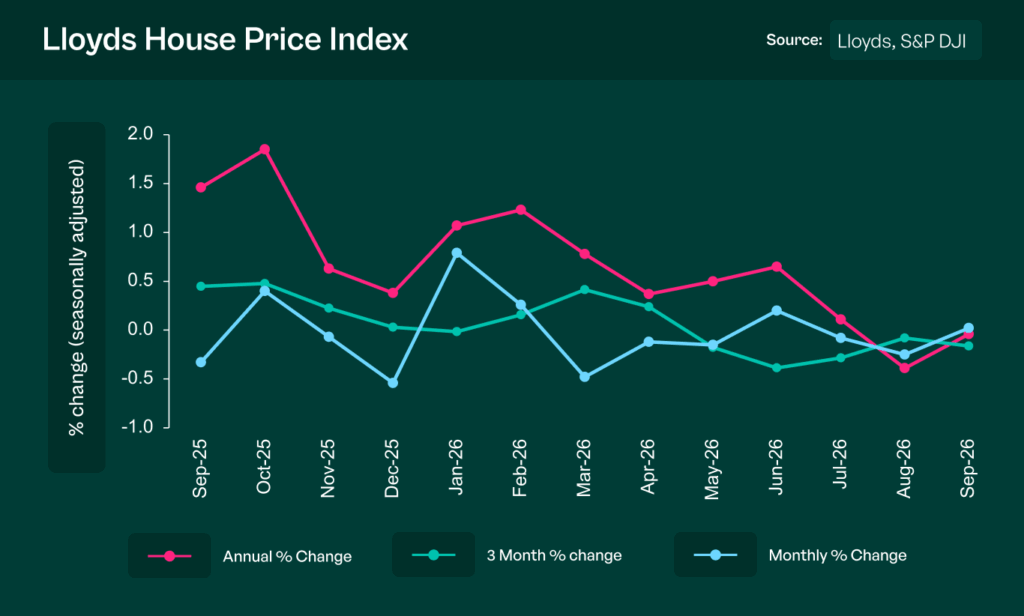
The latest Lloyds House Price Index shows UK house prices were unchanged in September, following a slight decline in August. The average property value stood at £298,441, while annual price growth was also flat at 0.0%.
The figures suggest the housing market is stabilising, but there is little evidence of renewed price momentum. Affordability remains a significant constraint, with elevated mortgage costs limiting purchasing power and buyers continuing to take a cautious approach.
National figures also conceal considerable variation between local markets. Differences in buyer demand, available housing stock and affordability mean individual locations can perform very differently from the UK average. For developers, understanding these local conditions remains particularly important when assessing acquisition opportunities and likely sales values.
While the absence of further price falls is encouraging, the wider picture remains one of subdued activity rather than a sustained recovery.
Andrew Asaam , Mortgages Director, comments:
While the market overall has been fairly subdued, property prices have so far proved resilient during a period of higher mortgage rates,” said Andrew Asaam, Mortgages Director at Lloyds. “That’s mirrored in wider economic data, with household spending holding up better than many expected despite energy and other cost pressures arising from the Middle East conflict.
Source: Lloyds House Price Index
What this means for SME developers:
Stable national prices provide some reassurance, but developers should avoid assuming that individual markets will follow the same pattern. GDV assumptions should reflect recent local comparable evidence, buyer affordability and competing supply. Realistic pricing and exit timescales remain essential, particularly where margins are tight.
2. Mortgage costs remain elevated – rate outlook stays uncertain

The outlook for borrowing costs remains uncertain. The Bank of England held Base Rate at 3.75% at its September meeting, marking a sixth consecutive decision to leave rates unchanged. The next decision is scheduled for 5 November.
However, inflationary pressures continue to complicate the outlook. UK CPI inflation reached 3.1% in August, above the Bank’s 2% target, while higher energy costs have increased concerns about further price pressures. The Monetary Policy Committee’s September vote was split 6–3, with three members favouring an immediate increase to 4.0%.
Mortgage pricing has also remained volatile. Following a series of increases during September and early October, some major lenders began reducing selected fixed-rate products in the second week of October. Nevertheless, average two-year and five-year fixed mortgage rates remained close to 6%, substantially above their levels at the beginning of September.
This combination of stable Bank Rate, persistent inflation and elevated mortgage pricing means the path towards cheaper borrowing remains difficult to predict. Mortgage affordability continues to influence buyer demand, particularly among households with smaller deposits or tighter borrowing capacity.
Source: Interest rates and bank rate – Bank of England
What this means for SME developers:
Developers should continue to account for elevated borrowing costs and their impact on buyer affordability. Appraisals should be resilient to different interest-rate and sales scenarios, without relying on significant mortgage-rate reductions to support projected GDVs or exit timescales.
3. New first-time buyer scheme – potential boost for new-build demand

he Government has announced plans for a new first-time buyer scheme designed to make new-build homes more accessible and support housing delivery in England.
The proposed Your First Home scheme would allow eligible first-time buyers to purchase a new-build property with a deposit of just 2.5%, supported by a government-backed equity loan of 20% of the purchase price. The equity loan would initially be interest-free, potentially reducing monthly mortgage payments compared with a conventional high loan-to-value mortgage.
The announcement comes against a backdrop of affordability pressures and subdued new-build demand. By reducing the deposit required and the size of the mortgage needed, the scheme could help more prospective buyers access homeownership while supporting developers’ sales pipelines.
However, important details remain outstanding. Household income limits, local property price caps, developer contributions and implementation arrangements are expected to be confirmed at the forthcoming Budget. Participating developers will also be required to contribute towards the scheme’s costs.
The proposals therefore represent a potentially significant intervention in the new-build market, although their eventual impact will depend on eligibility, uptake and the final terms.
Source: New first-time buyer scheme to be confirmed at Budget – Gov.uk
What this means for SME developers:
The scheme could widen the pool of potential buyers for qualifying new-build homes, particularly in markets where deposit requirements are a major barrier. Developers should monitor the final eligibility criteria, regional price caps and participation costs before incorporating any expected benefits into sales forecasts or project appraisals.
4. Planning permissions fall 12% – housing pipeline remains under pressure

The latest government planning statistics highlight continued pressure on England’s future housing pipeline. Provisional figures show that approximately 212,000 homes were granted detailed planning permission in the year to June 2026, down 12% from 242,000 in the preceding year.
The number of detailed residential permissions also declined, although by a smaller margin of 2%. This suggests that the reduction in the number of homes receiving permission is not simply a reflection of fewer planning decisions, but also changes in the scale and composition of schemes progressing through the system.
During the second quarter of 2026, local planning authorities granted 6,900 residential planning applications, down 2% year-on-year. More broadly, 65,200 planning decisions were granted across all development types, representing an 8% annual decline.
There is an important distinction between planning activity and housing delivery. The number of homes receiving permission provides an indication of the future development pipeline, but permissions do not necessarily translate into construction starts. Viability, funding, infrastructure requirements and market demand can all affect whether schemes progress.
The latest figures are provisional and may be revised upwards, but they underline the challenges facing housing supply despite ongoing efforts to reform the planning system.
Source: Planning applications in Emngland: April to June 2026 – Gov.uk
What this means for SME developers:
A weaker planning pipeline reinforces the importance of identifying deliverable sites and understanding local planning constraints before committing significant resources. Developers should assess planning timescales, infrastructure obligations and viability alongside market demand, ensuring projects remain commercially realistic from acquisition through to completion.
5. Construction downturn eases – early signs of stabilisation emerge
The UK construction sector showed further signs of stabilisation in September, with the S&P Global UK Construction PMI rising from 44.3 in August to 46.1. This was the highest reading for eight months and indicates that the pace of contraction has eased.
Although the improvement is encouraging, the index remains below the 50 threshold that separates growth from contraction. Construction activity therefore continues to decline overall, albeit at a slower rate than in recent months.
Housebuilding remained the weakest-performing part of the sector, reflecting the ongoing impact of elevated borrowing costs, subdued buyer demand and pressure on development viability. This continues to contrast with the Government’s ambitions to increase housing supply.
Nevertheless, the improvement in the headline index suggests that the sharp deterioration experienced earlier in the year may be moderating. A more stable construction environment could eventually support greater confidence in project delivery, although the latest figures do not yet signal a sustained recovery.
Source: Construction PMI slowest fall in UK output since January – ConstructUK
What this means for SME developers:
A slower construction downturn is encouraging, but developers should continue to plan around challenging delivery conditions. Realistic build programmes, robust contingencies and careful contractor selection remain important. Where reduced industry activity creates opportunities around contractor availability or procurement, these should be assessed against project-specific costs and delivery risks.
Steve Deutsch, CrowdProperty CEO, comments:
The latest figures reflect a market that is still facing challenges, but there are reasons for cautious optimism. House prices appear to be stabilising, construction activity is declining at a slower rate and the proposed first-time buyer scheme could provide welcome support for new-build demand. However, elevated borrowing costs and a weakening planning pipeline underline the importance of realistic appraisals, careful site selection and disciplined delivery. Developers who remain focused on viable opportunities will be best placed to navigate these conditions.
What this means for property investors
This month’s data presents a mixed picture for the UK property development market. House prices have stabilised, but elevated mortgage costs continue to affect affordability, while fewer planning permissions point to potential challenges for the future housing pipeline. At the same time, a slower construction downturn and proposed support for first-time buyers suggest some conditions could improve.
For property investors, these developments provide wider context for understanding the factors that can influence development activity, including local demand, project costs, planning requirements and sales timescales. The effects will vary between projects and locations, and proposed policy changes will take time to translate into measurable outcomes.
And finally…
Here are five timely reads to keep you informed this month:
- OBR should assess impact of Budget measures on housing market – The Intermediary
- Budget 2026: What does the property sector really need from the Chancellor? – Cowgills
- What would a Budget with reduced fiscal headroom mean for markets and investors? – Investment Week
- Government unveils cladding remediation bill – Development Finance Today
- Housebuilding target suffers blow with new figures – The Negotiator
Together we build

At CrowdProperty, we work in close partnership with the developers we back – solving site, funding and delivery challenges together. Our team of property experts visits sites, shares insights, and helps developers stay ahead of the market.
We’ve funded over £900 million in property projects, backed by 300+ years of combined property expertise. Our distinct ‘property finance by property people’ approach means we truly understand what developers need – and how to help them grow.
Learn more about our story and our team
Apply in just five minutes and get a Decision in Principle. Our property experts will then share their insights and initial funding terms, and work with you to find the right solutions to support the success of your project.
Explore projects we’ve already funded