
Welcome to State of the Market, our monthly roundup of key property market updates, with actionable insights for small and medium-sized property developers.
Key takeaways:
- House prices stall – affordability keeps the market subdued
- Rate outlook shifts – higher mortgage costs threaten affordability
- Construction downturn eases – early signs of stabilisation emerge
- Development finance remains available – lenders put strong schemes first
- Planning pipeline strengthens – developer appetite shows signs of recovery
1. House prices stall – affordability keeps the market subdued
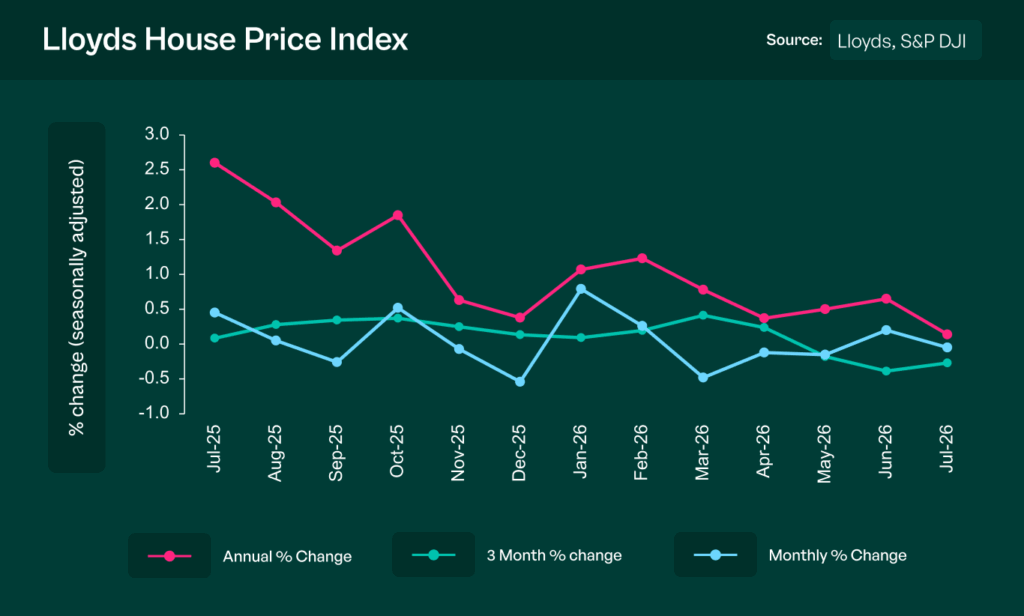
The latest Lloyds House Price Index shows UK house prices were broadly unchanged in July, with the average property valued at £299,253. Prices dipped by just £143 during the month, while annual growth slowed to 0.1% – the weakest rate recorded since November 2023.
The headline figure continues to mask significant regional differences. Northern Ireland recorded annual growth of 7.4%, followed by Scotland at 3.6%, while the North East and North West also remained comparatively resilient. In contrast, prices fell by 2.0% in the South East and 1.3% in London, highlighting the extent to which affordability and local market dynamics are influencing performance.
The figures suggest the market remains stable rather than experiencing a significant correction, but there is little evidence of renewed price momentum. Higher mortgage costs and wider economic uncertainty continue to constrain purchasing power, leaving buyers increasingly sensitive to price.
Source: Lloyds House Price Index
What this means for SME developers:
Headline house price stability should not be mistaken for uniform market conditions. Regional and local performance is becoming increasingly important, particularly as affordability pressures create greater variation between markets. Developers should ensure GDV assumptions reflect current comparable evidence and local purchasing power rather than relying on wider UK price growth.
2. Rate outlook shifts – higher mortgage costs threaten affordability

The outlook for borrowing costs has become less predictable. Bank Rate remains at 3.75%, but the Bank of England’s latest decision showed a more hawkish split than developers and homebuyers have become accustomed to, with three members of the Monetary Policy Committee voting to increase Bank Rate to 4.0%.
At the same time, fixed mortgage pricing has moved higher. Several major UK lenders increased rates during July as renewed geopolitical tensions pushed up energy prices and swap rates. Two-year swap rates, which influence fixed mortgage pricing, rose from 3.95% in late June to 4.22% by mid-July, reversing some of the improvement in borrowing conditions seen earlier in the year.
The latest market data shows that this pressure has continued. Five-year fixed UK mortgage rates rose to around 5.66% in July, their first increase since April, as inflation concerns and geopolitical uncertainty fed through into financial markets.
The implication is that the path towards cheaper borrowing is no longer straightforward. Higher energy prices present renewed inflation risks, while mortgage affordability remains one of the principal constraints on housing demand.
Sources: Monetary policy and summary July 2026 – Bank of England; Mortgage rates reversal wipes out a month of cuts – Moneyfacts
What this means for SME developers:
Developers should avoid assuming that borrowing costs or buyer mortgage rates will steadily decline over the course of a project. Appraisals should be resilient to different interest-rate and sales scenarios, with sufficient headroom if affordability remains constrained for longer than expected.
3. Construction downturn eases – early signs of stabilisation emerge
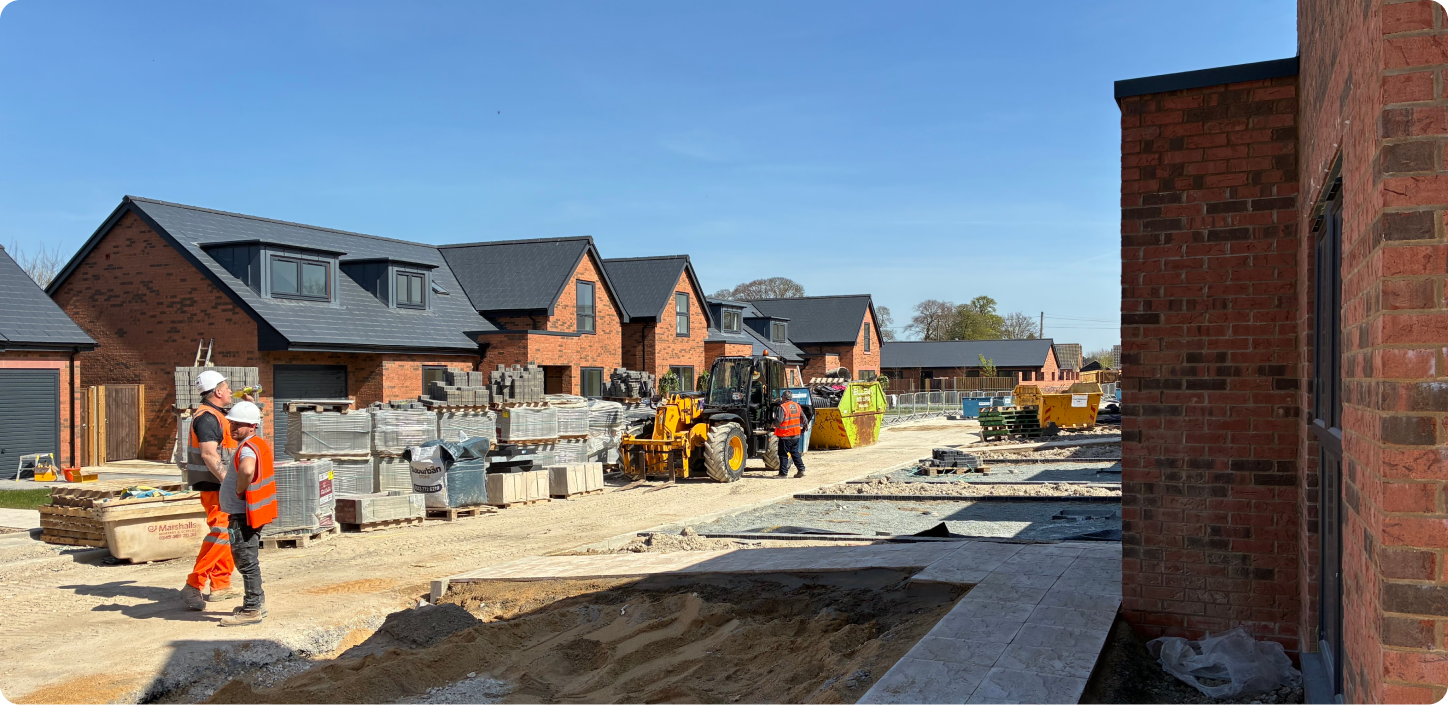
There were some encouraging signs from the construction sector in July, with the S&P Global UK Construction PMI rising sharply from 38.4 in June to 44.7. While a reading below 50 still represents contraction, this was the highest level for four months and suggests the sharp deterioration seen during the second quarter may be beginning to stabilise.
Housebuilding also improved, with its activity index rising to 41.8 and recording its slowest decline since October 2025. New orders across construction fell at their weakest rate since September last year, while business confidence reached a five-month high. Around 38% of surveyed firms expect activity to increase over the coming year, compared with 17% anticipating a decline.
Cost pressures are also moving in a more positive direction. Input price inflation eased to a five-month low and supplier performance improved, although construction businesses continue to report higher fuel and raw material costs linked to geopolitical disruption.
Sources: Construction output decline slows in July – Construction News; S&P Global UK Construction PMI – July 2026
What this means for SME developers:
The latest data provides grounds for cautious optimism, but conditions remain challenging. A slower contraction and easing input cost inflation should support greater visibility around delivery, although developers should continue to maintain robust contingencies and actively manage procurement. Stabilisation is encouraging, but it is not yet a return to growth.
4. Development finance remains available – lenders put strong schemes first

UK banks continue to provide credit despite greater economic uncertainty, with the Bank of England reporting that corporate lending has increased over recent quarters. Competition among lenders is also increasing, particularly for higher-quality borrowers.
However, access to finance is becoming more differentiated. The Bank’s latest Credit Conditions Survey found that overall corporate credit availability was unchanged during the second quarter, while availability decreased slightly for small and medium-sized businesses. This points to a lending environment where funding remains available, but the strength of the borrower and underlying proposition are increasingly important.
Source: Financial Stability Report July 2026 – Bank of England
What this means for SME developers:
Development finance remains available, but the quality of the proposition matters. Developers should approach lenders with realistic valuations and build costs, appropriate contingencies and a clear exit strategy. Working with a funding partner that understands property development can also help ensure finance is structured around the requirements of the individual project.
5. Planning pipeline strengthens – developer appetite shows signs of recovery

Housing planning activity is showing renewed momentum, with applications covering 412,130 new homes submitted across England in the year to June 2026. The first half of the year saw applications for 189,520 homes, making it the strongest first half of any year so far this decade. The increase provides an encouraging signal of developer intent. Every region outside London recorded year-on-year growth in housing applications.
However, a stronger planning pipeline does not automatically translate into homes being built. Housing starts remain well below application volumes, with viability, funding, infrastructure and local demand all influencing whether schemes progress from planning through to delivery. The latest figures therefore point to improving developer confidence, but converting that intent into viable projects remains the key challenge.
Source: Q2 Planning Application Index 2026 – TerraQuest
What this means for SME developers:
Growing planning activity is a positive sign for the development pipeline and suggests confidence is beginning to improve. For SME developers, the opportunity remains in identifying sites that can move efficiently from planning to delivery. Strong local demand, realistic costs, appropriate funding and manageable planning and infrastructure requirements will remain critical to turning opportunities into viable schemes.
Steve Deutsch, CrowdProperty CEO, comments:
The market remains challenging in places, but there are encouraging signs of stabilisation. Construction conditions are showing signs of improvement, development finance remains available for strong schemes and planning activity points to continued appetite to bring new homes forward. With affordability and borrowing costs still creating uncertainty, developers who focus on viable opportunities, maintain realistic assumptions and execute with discipline will be best placed to succeed.
And finally…
Here are five timely reads to keep you informed this month:
- Building costs seen as biggest barrier to new homes poll finds – The Intermediary
- Housing market revival key to construction recovery – PBC Today
- Construction building materials commentary July 2026 – Gov.uk
- Market in minutes: Residential development land Q2 2026 – Savills
- Build to rent starts plunge 79% – Property 118
Together we build

At CrowdProperty, we work in close partnership with the developers we back – solving site, funding and delivery challenges together. Our team of property experts visits sites, shares insights, and helps developers stay ahead of the market.
We’ve funded over £900 million in property projects, backed by 300+ years of combined property expertise. Our distinct ‘property finance by property people’ approach means we truly understand what developers need – and how to help them grow.
Learn more about our story and our team
Apply in just five minutes and get a Decision in Principle. Our property experts will then share their insights and initial funding terms, and work with you to find the right solutions to support the success of your project.
Explore projects we’ve already funded