
Welcome to State of the Market, our monthly roundup of key property market updates, with actionable insights for small and medium-sized property developers.
Key takeaways:
- House prices fall further – affordability weighs on demand
- Base Rate rises to 4% – inflation adds pressure to borrowing costs
- Autumn Budget offers targeted support – development viability remains under pressure
- New planning rules take effect – more decisions move to planning officers
- Development finance remains available – but market pressures slow activity
1. House prices fall further – affordability weighs on demand
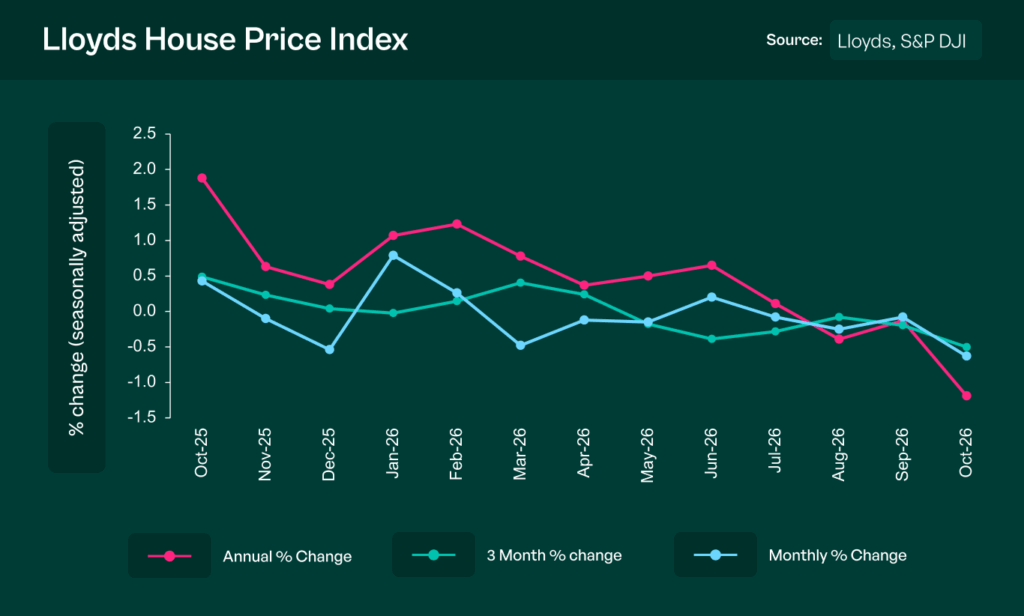
The latest Lloyds House Price Index shows UK house prices fell by 0.6% in October, following a 0.1% decline in September. The average property value now stands at £296,285, while annual prices are 1.2% lower – the largest annual fall since October 2023.
The figures mark a deterioration from the relatively stable conditions reported in September. Housing demand continues to be affected by elevated mortgage costs, inflationary pressures and uncertainty over the wider economic outlook.
However, national figures conceal significant regional differences. Some locations continue to experience annual price growth, while others face greater downward pressure as affordability constraints and competition between sellers influence buyer decisions.
The latest Rightmove House Price Index reinforces this picture, with average new seller asking prices falling 1.8% in November, compared with a typical seasonal decline of 1.1%. Sales agreed were also 7% below the same period last year, suggesting that buyers remain cautious despite having more properties to choose from.
The combination of softer prices and increased competition means developers need to assess local market conditions carefully, rather than relying on national averages or historic growth assumptions.
Source: Lloyds House Price Index
What this means for SME developers:
Softer prices and cautious buyer demand reinforce the importance of realistic GDVs and achievable sales rates. Developers should assess recent comparable transactions, competing developments and local affordability before committing to acquisitions. Where sales periods extend, additional holding and finance costs could have a material impact on project viability.
2. Base Rate rises to 4% – inflation adds pressure to borrowing costs

The Bank of England increased Base Rate by 0.25 percentage points to 4% on 5 November, ending a run of six consecutive decisions to leave rates unchanged.
The Monetary Policy Committee voted 8–1 in favour of the increase, with the remaining member preferring a larger rise to 4.25%.
The decision reflects renewed inflationary pressures, particularly from higher energy costs associated with the continuing conflict in the Middle East. Annual UK CPI inflation reached 3.5% in September, and the Bank now expects inflation to rise to around 5% by the middle of 2027 before gradually easing.
Higher interest rates create challenges for both developers and prospective buyers. Development borrowing costs may increase, particularly where finance is linked to Base Rate, while elevated mortgage rates continue to restrict affordability and purchasing power.
However, changes in Base Rate do not necessarily translate directly or immediately into equivalent movements in fixed mortgage rates. Lenders also consider funding costs, market expectations and competition when setting prices.
The outlook remains uncertain, with future decisions dependent on inflation, economic activity and the extent to which higher energy costs feed through into wider prices and wages. The next Bank Rate decision is scheduled for 17 December.
Source: November 2026 Monetary Policy Summary and Minutes – Bank of England
What this means for SME developers:
Developers should review the sensitivity of project appraisals to higher finance costs and longer development or sales periods. Where borrowing is variable-rate, changes in Base Rate can directly affect interest costs. Mortgage affordability should also be reflected in GDV assumptions, particularly for developments targeting first-time buyers or purchasers with smaller deposits.
3. Autumn Budget offers targeted support – development viability remains under pressure

The Autumn Budget, announced on 28 October, introduced several measures intended to support housing demand and development delivery, although the wider economic outlook remains challenging.
Among the most significant announcements was confirmation of £4.7 billion in funding for the Government’s Your First Home scheme. The initiative will provide eligible first-time buyers in England with a 20% equity loan towards a new-build property, alongside a deposit of between 2.5% and 15%.
The scheme is expected to support around 70,000 households, with the first loans anticipated from April 2027. It could provide a welcome stimulus for eligible new-build homes, although local property price caps, buyer eligibility and developer contributions will influence its practical impact.
The Budget also included proposals to improve development viability through brownfield biodiversity net gain exemptions, alongside continued investment in affordable housing and measures intended to support planning and delivery.
However, the Office for Budget Responsibility revised its forecast for UK economic growth in 2027 down from 1.6% to 1.0%, highlighting the continuing pressures facing households and businesses.
The Budget therefore presents a mixed picture. Targeted measures could support demand and improve the viability of certain developments, but higher borrowing costs, construction pressures and subdued market activity remain significant constraints.
Source: Autumn Budget 2026 – takeaways for developers and investors – CrowdProperty
What this means for SME developers:
The Budget introduces potential opportunities, particularly for developers delivering homes within the eligibility criteria for Your First Home. However, the scheme’s benefits should not be assumed before local price caps, developer contributions and buyer demand have been assessed. Developers should also monitor the implementation of proposed regulatory changes and consider how these could affect individual project costs and viability.
4. New planning rules take effect – more decisions move to planning officers

Significant changes to the planning system in England came into force on 31 October, introducing a new framework for determining which applications are decided by professional planning officers and which are referred to planning committees.
Known as the National Scheme of Delegation, the reforms aim to make decision-making more consistent and reduce unnecessary delays.
One of the most relevant changes for SME developers concerns smaller residential schemes. Applications for one to nine homes on sites smaller than 0.5 hectares will generally be determined by planning officers rather than committees, subject to certain exceptions.
Larger and more complex applications may still be referred to committee where specific criteria are met, but officer determination is now the default for a wider range of proposals.
The reforms also affect many technical planning applications, including the discharge of conditions, reserved matters, prior approvals and certain amendments to existing permissions.
Reducing routine committee referrals could make planning decisions more predictable and remove delays associated with meeting schedules. However, the changes do not guarantee faster approvals, and individual applications will still need to satisfy relevant planning requirements.
Source: New planning rules – what they mean for SME property developers – CrowdProperty
What this means for SME developers:
The changes could improve certainty for smaller residential developments, property conversions and projects requiring technical planning approvals. Developers should understand which applications fall within the new delegation framework and continue to allow realistic planning timescales in their programmes. Early engagement with planning officers and thorough applications remain important.
5. Development finance remains available – but market pressures slow activity
The Bank of England’s October Agents’ summary suggests that credit remains widely available, with banks, specialist lenders and private credit providers continuing to compete for stronger borrowers.
However, demand for new residential development finance is particularly weak, reflecting uncertainty, elevated borrowing costs and subdued housing-market conditions.
The Bank reports that some developers are seeking extensions to existing funding facilities because completed properties are proving difficult to sell. This highlights the growing importance of exit strategies and the relationship between development finance, buyer demand and sales timescales.
The findings are reinforced by the latest S&P Global UK Construction PMI, which shows a renewed deterioration in construction activity during October.
The headline index fell from 46.1 in September to 43.6 in October, remaining below the 50 threshold separating growth from contraction for the 22nd consecutive month.
Residential construction was particularly weak, with its index falling to 35.1 – the lowest reading since December 2025. Survey respondents cited subdued consumer confidence, rising borrowing costs and increased caution, while input-cost inflation accelerated to a four-month high.
The figures represent a reversal of September’s tentative improvement and underline the pressures facing housebuilders.
Taken together, the findings suggest that the availability of finance is not necessarily the principal constraint on development activity. Project viability, confidence in sales values and the ability to achieve timely exits remain equally important considerations.
Sources: Agents’ summary of business conditions October 2026 – Bank of England
UK Construction PMI October 2026 – S&P Global
What this means for SME developers:
Access to development finance remains important, but obtaining funding is only one part of delivering a successful project. Developers should demonstrate credible GDVs, realistic construction budgets and clearly evidenced exit strategies. Where sales are taking longer than anticipated, early discussions with funders can help identify potential refinancing or development exit requirements before existing facilities approach maturity.
Steve Deutsch, CrowdProperty CEO, comments:
The latest market figures underline the challenges facing SME property developers, with softer house prices, higher borrowing costs and subdued construction activity putting further pressure on viability. However, there are also positive developments. The Autumn Budget has introduced measures that could support housing demand, while changes to planning decisions may help reduce unnecessary delays for smaller projects. Access to finance remains important, but successful delivery depends on much more than funding alone. Realistic appraisals, experienced teams and well-considered exit strategies are essential in navigating current market conditions.
What this means for property investors
The latest developments highlight the continuing influence of interest rates, housing demand and construction activity on the property market. Softer house prices and longer sales periods can affect development timelines and refinancing requirements, while higher borrowing costs may place additional pressure on project viability.
At the same time, Government initiatives to support first-time buyers and improve planning processes could influence future housing delivery, although their impact will depend on implementation and wider market conditions.
For investors considering property-backed lending, these developments provide useful context for understanding the factors that can affect individual development projects, loan performance and repayment timescales. Property-backed investments remain subject to risk, including the potential loss of capital.
And finally…
Here are five timely reads to keep you informed this month:
- Nearly two thirds of SME housebuilders delay work as viability pressures mount – The Intermediary
- Government targets planning delays with new AI tool
- ‘No shortage of deals’ as developers await inflation relief – Development Finance Today
- Warning issued over Scheme of Delegation – Development Finance Today
- Vistry and Sanctuary enter 2,204 home JV – Development Finance Today
Together we build

At CrowdProperty, we work in close partnership with the developers we back – solving site, funding and delivery challenges together. Our team of property experts visits sites, shares insights, and helps developers stay ahead of the market.
We’ve funded over £900 million in property projects, backed by 300+ years of combined property expertise. Our distinct ‘property finance by property people’ approach means we truly understand what developers need – and how to help them grow.
Learn more about our story and our team
Apply in just five minutes and get a Decision in Principle. Our property experts will then share their insights and initial funding terms, and work with you to find the right solutions to support the success of your project.
Explore projects we’ve already funded